
Well, it’s not pretty! Post partum hemorrhage causes excessive blood loss either during delivery or immediately after. But what does that have to do with milk production? Let’s take a look.
The pituitary gland is responsible for secreting prolactin and oxytocin, two hormones essential for milk production and milk ejection. After post partum hemorrhage, the pituitary gland goes into shock and for a short time does not perform its regular duty.
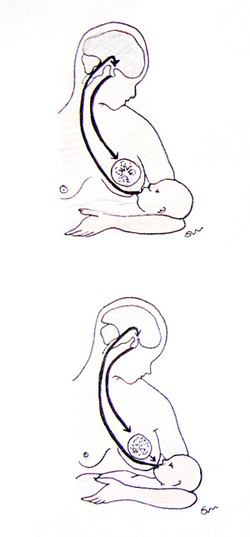
1. (Long arrow) Nerve impulses from sucking go to brain
2. (Short arrow) The pituitary gland releases prolactin into the blood
3. (Breast) This causes the alveolar cells to secrete milk and swells the alveoli
The Milk Ejection Reflex
1. (Long arrow) Nerve impulses from sucking go to the brain
2. (Short arow) The pituitary gland releases oxytocin into the bloodstream
3. (Breast) This causes muscles around the alveoli in the breast to squeeze milk to the nipple
It is important that mom feed or pump frequently to stimulate the prolactin and oxytocin frequently. After post partum hemorrhage, it is common to have delayed milk production for 4-6 days and insufficient milk supply for as much as two weeks or more. Mom and babe require close follow-up to ensure milk production and weight gain.
For more information on post partum hemorrhage or breastfeeding concerns, contact The Breast Start.